What Is PISA? The 2025 Global Results, Score Calculation and What It Means for Your Child's Future
I've been working in international education for over twenty years. And every three years, when the OECD publishes the PISA results, I experience the same quiet unease — not because the numbers are bad, but because most families never see them. They look at their child's school report, see good grades, and assume that's the full picture. It rarely is.
PISA tells a different story. It asks not "what has your child memorised?" but "what can your child actually do with what they know?" And in a world that increasingly values the ability to solve novel problems over the ability to recall stored answers, that distinction matters enormously.
What Is PISA?
PISA stands for Programme for International Student Assessment. It is run by the OECD PISA programme every three years, and it is the most comprehensive international comparison of educational outcomes in existence.
Three facts distinguish it from other assessments:
- Age-based, not grade-based. Any 15-year-old in a participating country can be selected, regardless of what year of school they are in.
- Genuinely global scale. In 2025, 91 countries and economies participated. Over 760,000 students were tested, representing approximately 33 million 15-year-olds worldwide.
- Applied skills, not curriculum knowledge. PISA does not test what students have been taught — it tests whether they can apply reasoning to real-world problems they have never seen before.
The three core domains are mathematics, science and reading comprehension. In 2025, a fourth domain was assessed for the first time: computational problem solving — not coding, but the capacity to think algorithmically, interpret data and solve problems in digital environments. This is the skill at the centre of the AI economy.
What would your child's PISA result look like? PISA works with national samples — individual children are never tested. But EduEntry's IRT-based assessment uses exactly the same methodology: adaptive questions across mathematics, verbal and quantitative reasoning in 20–35 minutes, producing a score benchmarked against peers from 91 countries. Free, no registration required.
Start Free Assessment →How Is a PISA Score Calculated?
PISA scores are calculated using Item Response Theory (IRT), not simple correct/incorrect counts. IRT accounts for each question's difficulty and the pattern of the student's answers, producing a latent ability estimate. All results are placed on a common scale where the OECD average is approximately 500 points, grouped into proficiency levels 1b through 6.
The test itself
Each student completes a two-hour test. Crucially, not everyone sees the same questions — different students receive different combinations of subject areas (science + reading, mathematics + science, etc.). This design allows PISA to cover far more ground than any individual student could answer while keeping test time manageable.
After the test, students complete a 35-minute background questionnaire covering family circumstances, learning habits, digital device use, attitudes to school and wellbeing. This contextual data is what allows PISA to separate system effects from socio-economic effects.
Item Response Theory (IRT)
PISA scores are not based on raw correct/incorrect counts. They use Item Response Theory (IRT) — a statistical framework that accounts for each question's difficulty and discriminating power, as well as the pattern of each student's responses. The result is a latent ability estimate rather than a simple sum.
All scores are then placed on a common scale normalised so that the OECD average sits near 500 points. This means a Turkish student's score can be directly compared with a Japanese, Finnish or Singaporean student's score.
Proficiency levels
| Level | What it means | OECD view |
|---|---|---|
| Below Level 1b | Cannot complete even the most basic tasks | Critical concern |
| Level 1a/1b | Only the simplest, most direct tasks | Insufficient |
| Level 2 | Baseline competency — minimum for modern life | Baseline threshold |
| Level 3–4 | Can handle moderately complex tasks independently | Adequate |
| Level 5–6 | Abstract reasoning, creative problem solving | Globally competitive |
Level 2 is the critical threshold. Students who cannot reach it face serious difficulties functioning independently in modern society — and in the labour market. Level 5–6 is where global competitive advantage begins.
PISA 2025: What the Global Results Show
The PISA 2025 results, published 8 September 2026, reveal a picture that should give pause to education systems and families worldwide.
Overall: performance stagnating or declining across most OECD countries
Across OECD countries, average scores in science fell modestly between 2015 and 2025. Reading saw particularly large drops in many systems. Mathematics broadly held. The OECD's own characterisation: "largely stagnating or continuing to decline."
This is the global backdrop. Against it, countries that improved stand out sharply.
Top performers in PISA 2025
| Country / Economy | Position | Note |
|---|---|---|
| China (B-S-J-Z) | 1st | 54% top performers in mathematics |
| Singapore | 2nd | 37% top performers in mathematics |
| Japan, Korea, Chinese Taipei | Top 5 | Consistently high across all domains |
| Estonia, UK | Top 10 | Highest-performing European systems |
| OECD average | — | ~500 pts; declining trend since 2015 |
New in 2025: computational problem solving and AI
The 2025 cycle introduced the first ever assessment of computational problem solving — the ability to use algorithmic thinking, conduct experiments and build solutions in digital environments. This is not coding; it is the cognitive infrastructure that makes AI tools useful rather than passive.
PISA also collected unprecedented data on AI use in education. The finding that has generated the most discussion: students who used AI chatbots for specific schoolwork tasks (summarising, drafting, researching) scored lower in science than students who did not. Passive AI use appears to displace rather than augment thinking.
Turkey in PISA 2025: The Encouraging and the Concerning
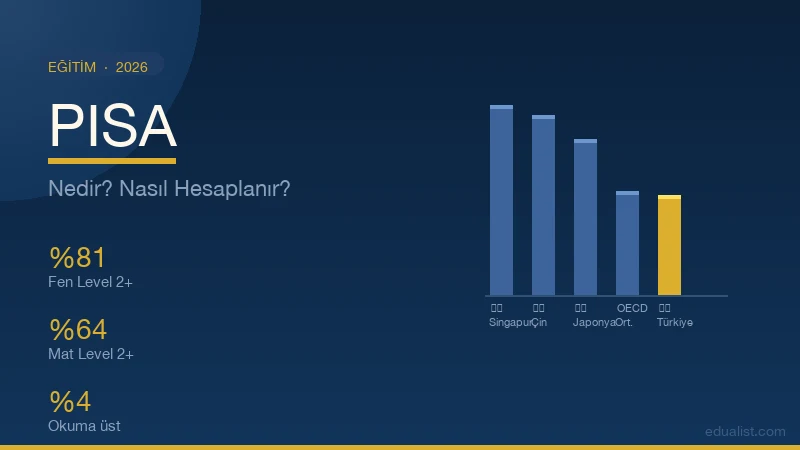
Turkey is one of the few countries to have improved in all three core subjects between 2022 and 2025. Against a backdrop of widespread global decline, this is a genuine achievement.
| Domain | Turkey Level 2+ | OECD Average |
|---|---|---|
| Science | 81% | 74% |
| Reading | 76% | 69% |
| Mathematics | 64% | 65% |
Turkey is above the OECD average in science and reading, and essentially at the average in mathematics. Since 2015, the proportion of low-performing students has fallen by 16 percentage points in mathematics and 25 percentage points in science. These are real, systemic gains.
But the top-performer picture tells a different story:
| Domain | Turkey Level 5–6 | OECD Average | Singapore |
|---|---|---|---|
| Mathematics | 8% | 8% | 37% |
| Science | 7% | 7% | — |
| Reading | 4% | 6% | — |
Turkey is at the OECD average for top performers — but the OECD average is not a globally competitive benchmark. In computational problem solving, Turkey scored below the OECD average. And 53% of Turkish students reported skipping at least one school day in the two weeks before the test, compared to an OECD average of 22%.
The honest summary: Turkey's floor is rising, but its ceiling is not.
Why PISA Skills Predict Career Success
This is the question that gets asked least and matters most: does any of this translate into real life?
The answer, backed by OECD longitudinal research across dozens of countries, is yes — strongly. The skills PISA measures correlate with adult earnings, employment quality, health outcomes and civic participation. Not weakly, not ambiguously: the relationship is robust and consistent across systems.
Here is why, concretely:
Reading comprehension → every knowledge-economy role
Parsing a contract, interpreting a research report, writing instructions a team can follow, identifying the flaw in a proposal — these all require the same underlying skill PISA measures in reading. A student who cannot reach Level 2 in reading will struggle with every white-collar role that exists. A student at Level 5–6 will learn new roles faster than their peers, every time.
Quantitative reasoning → decision-making under uncertainty
Managing a project budget, evaluating risk, reading a P&L, interpreting clinical data, understanding interest rates — none of these require advanced mathematics. All of them require the numerical reasoning PISA measures at Levels 2–4. This is not a skill for mathematicians; it is a skill for anyone who will ever need to make a consequential decision.
Computational problem solving → the AI economy
The ability to think algorithmically — to decompose a problem, design a process, test a solution — is what separates someone who uses AI tools productively from someone who is replaced by them. PISA measured this for the first time in 2025. Countries that score well here are building workforces suited to the next fifty years of the economy. Countries that score poorly are not.

In twenty years of working with families navigating international education, the most common pattern I see is this: a child who is excellent by their domestic system's standards arrives in an international setting and encounters an unexpected gap. The gap is not about intelligence. It is about the kind of thinking the system practised. PISA makes that gap visible — and visible early enough to close.
What Would Your Child's PISA Score Be?
PISA does not test individual children. It constructs a statistical portrait of a country's 15-year-olds by testing a representative sample. Your child's "PISA score" is never officially calculated.
But the question is worth asking: if your child had sat the test alongside 760,000 peers from 91 countries, where would they land? At the OECD average? In the top 16%? In the bottom quarter?
The only way to answer this for an individual child is through an assessment built on the same methodology — IRT — that PISA uses. IRT adapts to each child's responses in real time, accurately placing both struggling and high-performing students on the same international scale.
EduEntry's academic assessment is built on exactly this foundation. Children aged 6–17 answer adaptive questions in mathematics, verbal reasoning, quantitative reasoning and English. The result is a standardised score aligned to the same international scale as PISA — showing not where your child sits within their school, but where they sit within the global distribution.
The assessment takes 20–35 minutes, is completely free and requires no registration. Results appear immediately, with sub-scores across all four domains and a global percentile comparison.
Find out where your child ranks in the world — free
EduEntry's assessment uses the same IRT methodology as PISA. 20–35 minutes, free, no registration. Instant results with global percentile benchmarking across four domains.
Start Free Assessment →What Should Families Do?
1. Stop measuring your child against their class
2. Prioritise applied skills over content knowledge
3. Take computational skills seriously
4. Use AI as a thinking partner, not a shortcut
Frequently Asked Questions
What is PISA in simple terms?
PISA is the world's largest international education assessment. Every three years, the OECD tests 15-year-olds across 91 countries in mathematics, science and reading. In 2025, computational problem solving was added. PISA measures applied skills — not what students have memorised, but what they can actually do with what they know.
What were the PISA 2025 results?
Results were published 8 September 2026. Top performers globally: China (B-S-J-Z), Singapore, Japan, Korea, Estonia and the UK. Most OECD countries saw stagnating or declining scores, particularly in reading. Turkey was among a small number of countries that improved in all three core subjects compared to 2022.
How are PISA scores calculated?
PISA uses Item Response Theory (IRT) — a statistical model that accounts for question difficulty and each student's response pattern. Scores are normalised to an OECD average of approximately 500 points. Results are grouped into 7 proficiency levels (1b to 6); Level 2 is the baseline competency threshold and Level 5–6 represents globally competitive performance.
What is a good PISA score?
The OECD average is approximately 500 points. Level 2 is the minimum considered adequate for modern life (around 407–480 points depending on the domain). Level 5–6 (above 607 points) represents globally competitive students. Singapore consistently places 37% of students at Level 5–6 in mathematics; Turkey places 8% — equal to the OECD average.
Does PISA predict career success?
Yes. OECD longitudinal research consistently shows that the skills PISA measures — reading comprehension, quantitative reasoning and problem solving — correlate strongly with adult earnings and employment quality across all participating countries. These are not test-taking skills; they are the cognitive foundations of knowledge-economy work.
Can my child take a PISA-equivalent test?
PISA does not test individuals. But EduEntry's academic assessment uses the same IRT methodology, giving children aged 6–17 an internationally benchmarked score across mathematics, verbal reasoning, quantitative reasoning and English. It takes 20–35 minutes, is free, and requires no registration. Start at eduentry.com/tr#akademik.
PISA 2025 Turkey Results: The Numbers Look Better Than They Are →
PISA 2025 and Early Work Experience: The Missing Link →
PISA Nedir? (Turkish guide) →
Where does your child stand in the world?
Book a free session with Özlem Çimen to understand your child's international academic position and the most effective next steps for their education.
Start Free Assessment → Free Consultation with Özlem Çimen