Cost of Living in Dubai 2026: Real Numbers for Families
For a family of four in Dubai, monthly costs range from 18,700 AED (budget — KHDA Good school, JVC apartment) to 50,500 AED (premium IB school, Emirates Hills villa). The figure that surprises most families: zero income tax means every dirham you earn is yours to keep, making Dubai's real cost significantly lower than the gross equivalent in most countries.
1. Rent
Rent is the single largest cost category in Dubai. Which neighbourhood you choose directly affects both the rent level and your child's commute to school.
| Area | Property type | Annual rent (AED) | Monthly equiv. |
|---|---|---|---|
| JVC, DSO, Al Barsha | 2-bed apartment | 80,000–100,000 | 6,600–8,300 AED |
| JVC, JLT, Motor City | 3-bed apartment | 110,000–140,000 | 9,200–11,700 AED |
| Jumeirah, Arabian Ranches | 3-bed villa/apt | 155,000–195,000 | 12,900–16,300 AED |
| Emirates Hills, Meadows | Villa | 220,000–350,000 | 18,300–29,200 AED |
| Palm Jumeirah | Villa / Penthouse | 350,000+ | 29,200+ AED |
Important: Dubai rent is typically paid upfront in 1–4 cheques per year. Monthly payment is rare and more expensive. Before moving, you need enough in your account to cover the first year's rent in full.
2. School Fees
School fees are as significant as rent. KHDA Outstanding schools vary by year group. If you're looking to offset some of this cost, see our Dubai school scholarships guide.
| School category | Annual fees (AED/child) | Monthly equiv. |
|---|---|---|
| KHDA Acceptable / Good | 18,000–35,000 | 1,500–2,900 AED |
| KHDA Very Good | 35,000–55,000 | 2,900–4,600 AED |
| KHDA Outstanding | 55,000–90,000 | 4,600–7,500 AED |
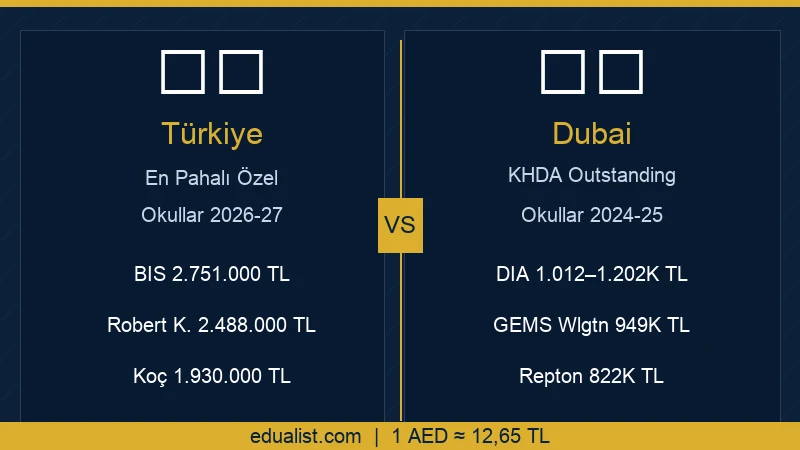
| Premium IB (DIA, GEMS Wellington) | 80,000–105,000 | 6,700–8,800 AED |
Fees are typically paid in three terms (September, January, April). KHDA caps annual fee increases based on inspection rating — Outstanding schools are generally limited to 3–5% annual rises.
3. Groceries and Dining
Supermarket shopping in Dubai is slightly more expensive than Turkey but less so than most people expect. Lulu Hypermarket and Carrefour are the main chains with reasonable prices. Turkish products (olive oil, cheese, tea) are available but carry an import premium.
- Mostly home cooking: 2,000–3,000 AED
- 1–2 restaurant meals per week included: 3,000–4,500 AED
- Frequent dining out / fine dining: 5,000+ AED
Casual restaurant: 100–200 AED for two. Mid-range: 200–400 AED. Fine dining: 400–800 AED. Fast food (McDonald's, KFC): 40–70 AED per person.
4. Transport
A car is near-essential in Dubai — the metro covers limited routes and most school buses are charged separately. Petrol is very cheap (~3 AED/litre), but the main cost is vehicle finance and insurance.
| Item | Monthly cost (AED) |
|---|---|
| Car loan (mid-range, 5-year term) | 1,500–2,500 |
| Petrol (~60 litres/month) | 180–220 |
| Car insurance (monthly) | 200–400 |
| Salik tolls + parking | 100–300 |
| School bus (optional) | 300–600 / child |
| Uber/Careem (supplementary) | 300–600 |
Total monthly transport for a two-car family: 3,500–6,000 AED.
5. Health Insurance
Health insurance is mandatory in Dubai. Employers typically cover the employee's basic policy; a top-up is needed for spouse and children.
- Basic family policy (spouse + 2 children): 600–1,200 AED/month
- Comprehensive policy (private hospitals included): 1,500–3,000 AED/month
- If employer covers employees: 0–500 AED/month (difference premium only)
6. DEWA (Electricity + Water) and Internet
Electricity and water are supplied by DEWA. Air conditioning running continuously in summer significantly increases bills.
| Item | Winter (Oct–Mar) | Summer (Apr–Sep) |
|---|---|---|
| DEWA (2-bed apartment) | 400–600 AED | 800–1,400 AED |
| DEWA (3-bed villa) | 700–1,000 AED | 1,500–2,500 AED |
| Internet (Du / Etisalat) | 300–500 AED/month | |
7. Three Family Scenarios (Monthly)
All figures below are based on a family of four (2 adults, 2 children).
| Item | Budget | Mid-range | Premium |
|---|---|---|---|
| Area | JVC / Al Barsha | Jumeirah / Arabian Ranches | Emirates Hills / Meadows |
| Rent | 8,000 AED | 14,000 AED | 22,000 AED |
| School (2 children, monthly) | 3,500 AED | 6,000 AED | 9,000 AED |
| Groceries / food | 2,500 AED | 3,500 AED | 5,000 AED |
| Transport | 2,000 AED | 3,500 AED | 5,500 AED |
| Health insurance | 800 AED | 1,500 AED | 2,500 AED |
| DEWA + internet | 900 AED | 1,500 AED | 2,500 AED |
| Entertainment / clothing / misc | 1,000 AED | 2,000 AED | 4,000 AED |
| TOTAL / month | 18,700 AED | 32,000 AED | 50,500 AED |
8. The Tax Advantage: The Number Behind the Numbers
Looking at the mid-range scenario — 32,000 AED/month — and thinking "that's expensive"? Run the tax calculation first.
In most countries, to spend the equivalent net each month, you'd need to earn significantly more gross to cover income tax, social security and other deductions — often 40–50% more. In Dubai, to spend 32,000 AED/month you need to earn exactly 32,000 AED. There is no income tax. What you earn is what you keep.
Monthly Family Budget: All Line Items in One Table
The table below breaks down all major monthly expenses for a family of four across three budget tiers. Use it as a planning reference and as a benchmark when negotiating a salary package.
| Line item | Budget (AED/month) | Mid-range (AED/month) | Premium (AED/month) |
|---|---|---|---|
| Rent | 7,000–8,500 | 12,000–15,000 | 20,000–30,000 |
| School fees (2 children, monthly) | 2,500–4,000 | 5,500–7,500 | 9,000–15,000 |
| Groceries / food | 2,000–2,800 | 3,000–4,000 | 4,500–7,000 |
| Transport | 1,500–2,500 | 2,500–4,000 | 4,500–7,000 |
| Health insurance (family) | 600–900 | 1,200–1,800 | 2,000–3,500 |
| Restaurants / dining out | 500–1,000 | 1,500–2,500 | 3,000–5,000 |
| Entertainment / activities | 500–800 | 1,000–2,000 | 2,500–5,000 |
| Electricity / water (DEWA) | 500–900 | 900–1,400 | 1,500–2,500 |
| Phone / internet | 300–450 | 400–600 | 600–900 |
| TOTAL / month | ~15,400–21,900 | ~28,000–38,800 | ~47,600–75,900 |
Neighbourhood Comparison: Marina, JBR, JVC, Downtown, Arabian Ranches, The Springs
Where you live in Dubai shapes both your rent bill and your quality of life. The table below gives typical 3-bedroom flat rents and a profile of each neighbourhood most popular with expat families.
| Neighbourhood | 3-bed Annual Rent (AED) | Monthly Equiv. | Profile |
|---|---|---|---|
| Dubai Marina / JBR | 160,000–220,000 | 13,300–18,300 | Sea views, dense expat community, vibrant street life |
| Jumeirah Village Circle (JVC) | 105,000–140,000 | 8,750–11,700 | Affordable, family-friendly, rapidly improving infrastructure |
| Downtown Dubai | 200,000–280,000 | 16,700–23,300 | Central, Burj Khalifa proximity, prestige address |
| Arabian Ranches | 170,000–230,000 | 14,200–19,200 | Villa communities, quiet family environment, green space |
| The Springs / Meadows | 145,000–190,000 | 12,100–15,800 | Townhouses and villas, close to schools, established community |
| Jumeirah 1–3 | 155,000–210,000 | 12,900–17,500 | Established neighbourhood, close to JESS and nearby schools |
Rent + School: The Combined Reality Check
For Turkish families relocating to Dubai, rent and school fees together account for 55–65% of the total monthly budget. Everything else sits on top of this base. Here's how the combination plays out across budget tiers:
| Scenario | Area + Rent (AED/month) | School 2 children (AED/month) | Rent + School Total | Est. Full Budget |
|---|---|---|---|---|
| Budget | JVC · 8,000 | KHDA Good · 3,000 | 11,000 | ~18,000–22,000 |
| Mid-range | Springs · 13,000 | KHDA Outstanding · 6,500 | 19,500 | ~30,000–36,000 |
| Premium | Arabian Ranches villa · 20,000 | Premium IB · 12,000 | 32,000 | ~50,000–60,000 |
The practical takeaway: the two decisions that determine your total budget more than anything else are your neighbourhood choice and school category. Dropping one KHDA tier (Outstanding to Very Good) or one neighbourhood tier (Jumeirah to Springs) saves 5,000–8,000 AED/month — more than any other single line item.
Dubai vs Istanbul vs London vs Singapore: Cost of Living Index
To put Dubai in a global context, the table below compares monthly costs for a mid-range family of four — in USD — across four cities frequently considered by internationally mobile families (2026 approximate figures).
| City | 3-bed Rent (USD/month) | Intl School 2 children (USD/month) | Total Family Budget (USD/month) | Income Tax Rate |
|---|---|---|---|---|
| Dubai | 3,500–5,000 | 2,000–4,000 | 8,000–12,000 | 0% |
| Istanbul | 1,200–2,500 | 2,500–5,000 | 6,000–11,000 | 15–40% (progressive) |
| London | 3,800–6,500 | 2,500–5,500 | 11,000–18,000 | 20–45% (UK income tax) |
| Singapore | 3,200–5,500 | 2,000–4,500 | 9,000–14,000 | 0–24% (avg ~15%) |
Dubai vs Other Countries: Honest Comparison
Dubai Advantages
- Zero income tax — gross salary = net salary
- AED/USD-linked income — protected from currency devaluation
- KHDA inspection system makes school quality transparent
- All living costs in AED — single currency exposure
- International environment with long-term benefits for children
Dubai Disadvantages
- Rent paid upfront — high cash requirement in year one
- Summer heat — high AC costs and limited outdoor life
- No state pension — retirement planning is personal
- No Turkish-language school — language adaptation required
- Distance from extended family and familiar culture
Frequently Asked Questions
What is the monthly cost of living in Dubai for a family of four?
As of 2026, between 18,700 and 50,500 AED/month depending on neighbourhood and school choice. A family in JVC with a KHDA Good school: ~18,700–22,000 AED. Jumeirah with an Outstanding school: 28,000–35,000 AED. Villa and premium IB: 45,000 AED+.
How much is rent in Dubai?
A 2-bed apartment in JVC runs 80,000–100,000 AED/year (~7,500 AED/month). A 3-bed in Arabian Ranches or Jumeirah: 155,000–195,000 AED/year. Villas in Emirates Hills start at 220,000 AED/year. Rent is typically paid in 1–4 upfront cheques.
Is there income tax in Dubai?
No. Dubai has no personal income tax. Your gross salary is your net salary. This effectively makes Dubai's cost of living 30–40% more affordable in real terms compared to the equivalent gross income required in most countries.
Is health insurance mandatory in Dubai?
Yes. Employers provide the employee's basic policy; families typically pay a top-up for spouse and children. A comprehensive family policy runs 600–2,500 AED/month depending on coverage level.
How do I calculate a Dubai family budget including school fees?
Rent + school typically accounts for 55–65% of the total budget. Mid-range example: 14,000 AED rent + 6,000 AED school for 2 children = 20,000 AED fixed costs. Add groceries, transport, DEWA and insurance and you reach 30,000–35,000 AED/month.
Which Dubai Neighbourhood to Live In? School-Based Area Guide →
Dubai's Best International Schools 2026: Fees and KHDA Ratings →
Dubai School Scholarships 2026: How to Reduce School Fees →
Let's build your personal Dubai budget
Based on your salary, your children's ages and your school preferences, we'll put together a personalised cost analysis in one session.
Book a Free Consultation