Teen Mental Health in the Digital Age: The Anxious Generation
Together with the school counsellor at GEMS DAA (Dubai American Academy), we are reading Jonathan Haidt's The Anxious Generation chapter by chapter. In this first instalment we cover the book's opening argument — the "Growing Up on Mars" metaphor — and the four developmental harms Haidt identifies as the cost of a phone-centric childhood.
Children's and teenagers' mental health has been going through an unprecedented crisis over the last decade. At GEMS DAA we decided to examine this closely with our school counsellor, working through Jonathan Haidt's landmark book The Anxious Generation in depth. We're sharing what we find, chapter by chapter, here on Edualist — for parents, educators and anyone who wants to understand today's young people better.
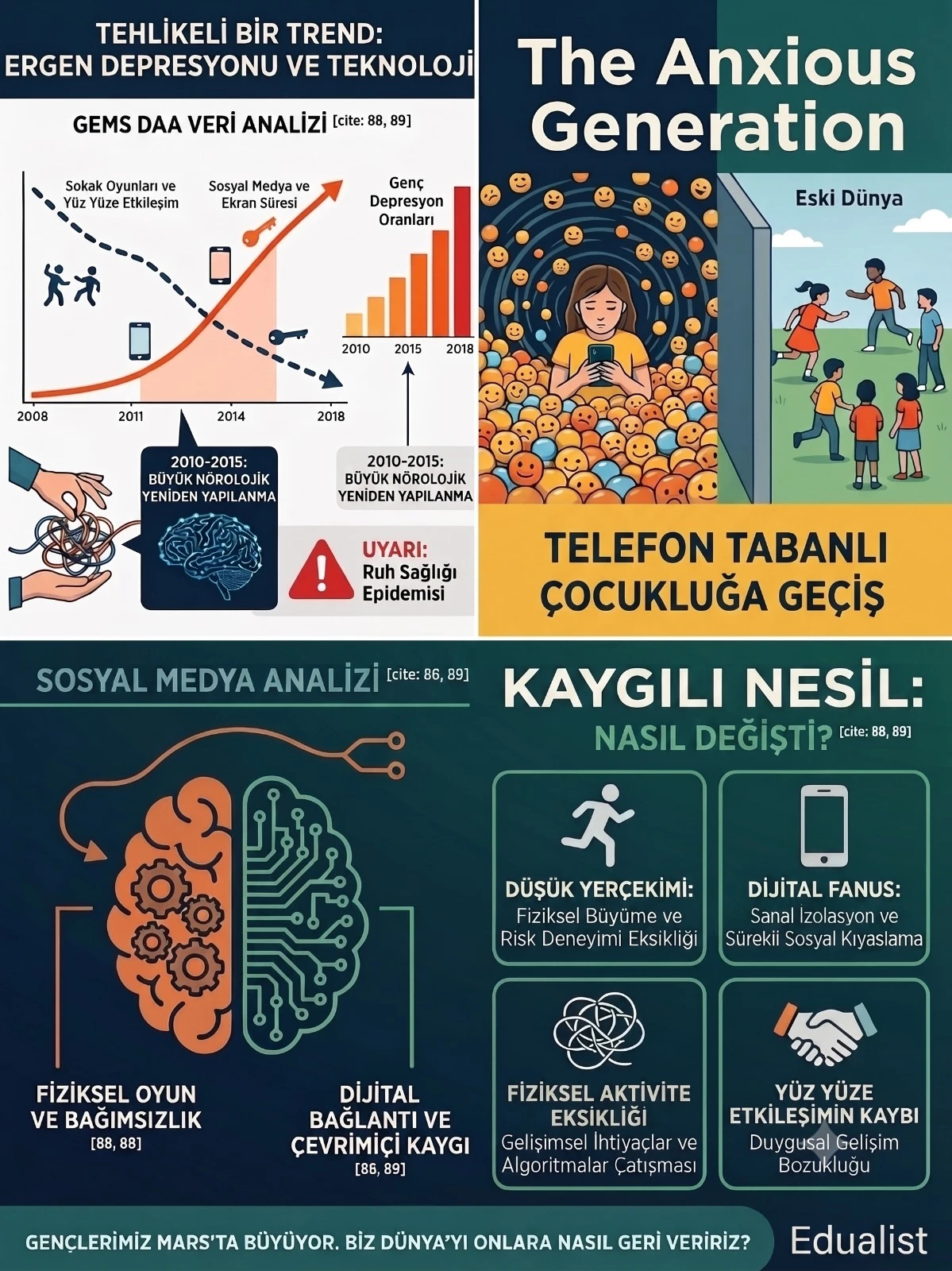
The Mars Metaphor
Haidt opens the book with a thought experiment: imagine taking your children to a new colony on Mars, where gravity is too weak to build strong bones, there is no breathable atmosphere, and everything happens inside artificial domes. Human biology has never adapted to such an environment. How would your children's physical, mental and emotional development suffer?
His point: Generation Z is the first generation to grow up on "Mars" — not literally, but developmentally. The human brain and body evolved over hundreds of thousands of years to need physical risk, face-to-face interaction, free play and contact with the natural world. When those experiences are replaced by screens, development suffers in ways analogous to bones in low gravity.
From Free Play to Phone-Centric Childhood
For millennia, childhood was shaped around free play: friendships formed face to face, streets where children ran and fell, conflicts resolved without adult referees, physical activity as a constant. Then, from around 2012, smartphones became ubiquitous among teenagers and social media moved to the centre of adolescent life. Children migrated from the real world to a virtual one. That is the "Mars" Haidt is talking about.
The Great Rewiring: 2010–2015
The data Haidt presents is striking. Between 2010 and 2015, rates of clinical depression among 12–17-year-olds — especially girls — rose by more than 50%. Anxiety disorders, self-harm and suicidal ideation climbed in parallel. The timing was too globally synchronised to be explained by economic downturns or academic pressure alone. The single most consistent variable: the spread of smartphones and social media.
Four Developmental Harms
1. Low gravity — loss of physical risk experience. Children build resilience by taking risks, falling, and getting back up. Screens eliminate that opportunity. The result: a generation that overreacts to life's small difficulties.
2. The digital dome — social comparison on loop. Social media promises connection but delivers the opposite: a 24/7 stream of curated, filtered lives to measure yourself against. The social pressure that used to end at the school gate now follows teenagers into bed.
3. Physical inactivity. Every hour on screens is an hour not moving. Movement is not a luxury for the developing brain — it is essential for attention, emotional regulation and executive function.
4. Loss of face-to-face interaction. Empathy develops by reading faces. Conflict resolution requires real-time verbal and non-verbal feedback. These cannot be learned through emojis and TikTok comments. The result: a generation that is uncomfortable in person, lonely, yet also afraid of being alone.
What We're Seeing at GEMS DAA
Reading Haidt, we recognised our own students on the pages. Our school counsellor reports that the most common issues over recent years are social anxiety, identity uncertainty and sleep disorders — three that are deeply interconnected. A teenager scrolling social media until midnight loses sleep quality and arrives at school the next morning already burdened by hours of social comparison.
What Can Parents Do?
Allow boredom. Prioritise physical experiences. Set screen time boundaries — and explain the reasoning behind them. Consider delaying social media access; Haidt's recommendation is age 16. The next instalment of this series will go deeper into the neuroscience of social media algorithms and the dopamine loop. Stay tuned.
Let's talk about your child's wellbeing
Free consultation on school selection, mental health readiness and adaptation support.
Book a Free Consultation